A Staying in History Feature

Waukesha: The Saratoga
of the West

How mineral water turned a small Wisconsin city into one of America's grandest resort destinations — and the hotels that defined its golden age

1868 — 1918

Scroll

There was a time when people came to Waukesha to be healed. Not in the way people talk about rest and renewal now. They came because they were sick, or believed they might be, and because word had spread across the country that the water bubbling up through the limestone beneath this small Wisconsin prairie town could do things that doctors couldn't.

They came by the thousands. Then by the trainload. At the peak of the Waukesha Springs Era, twenty-five trains a day pulled into the depot carrying visitors with names like Laflin and Bryan and Lincoln, all hoping a few glasses of mineral water might change their lives. The hotels that rose to meet them were something else entirely.

Over fifty mineral springs flowed across Waukesha County. The town earned the nickname The Saratoga of the West. And for roughly forty years, the hotels that rose around those springs made the comparison feel almost modest.

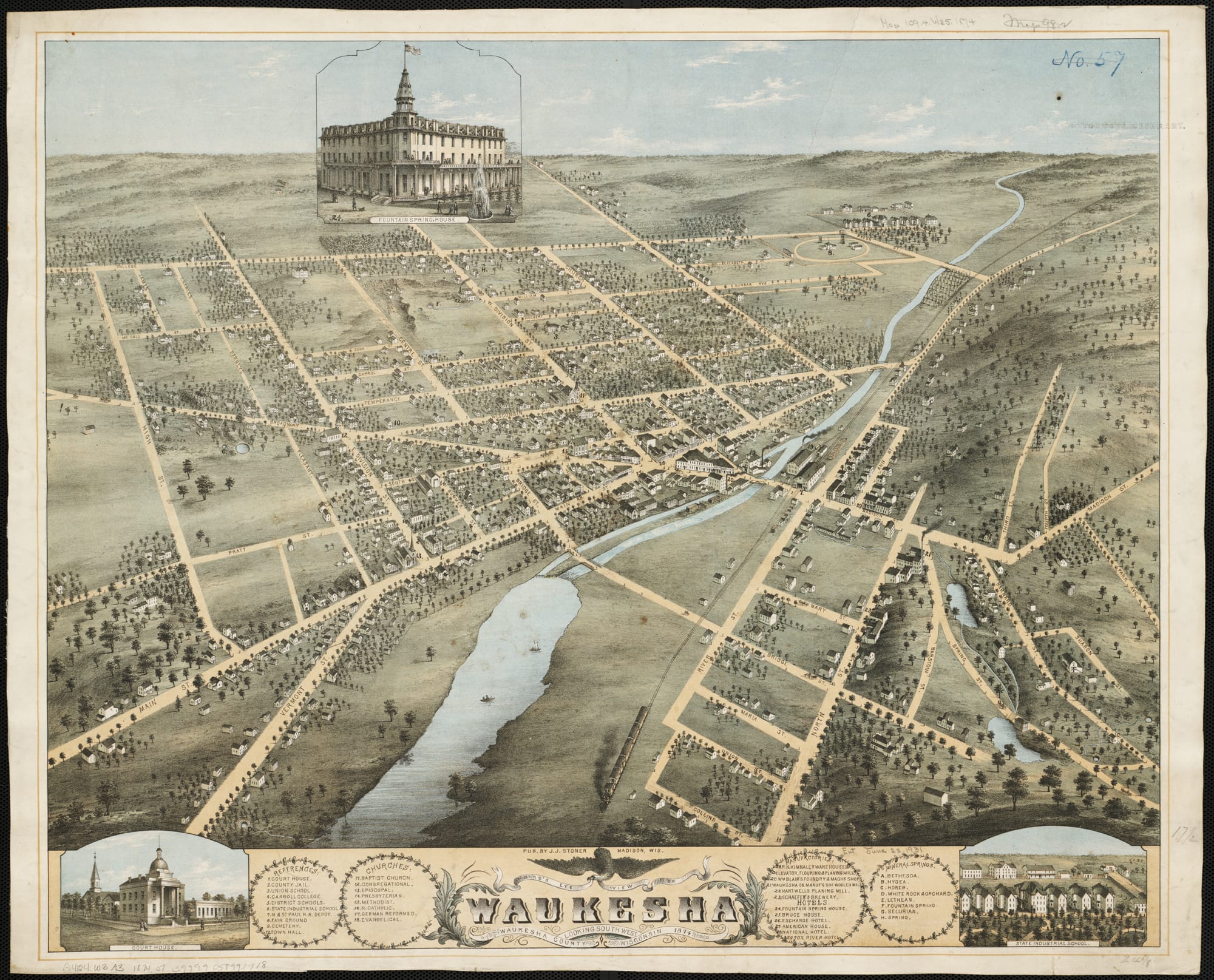
View of Waukesha, Wisconsin during the Springs Era

Waukesha at the height of the Springs Era, when visitors from across the country came seeking the healing waters of the Saratoga of the West.

"Watch the almost unbelievably clear waters rise from the mirrored pebbled bottom and flow over the edge of the pool into a drain." George W. Macauley, recalling childhood visits to the Fountain Spring, c. 1890s
Hotel Status
Gone
Partially surviving
Building survives
Seven properties that defined an era
The Hotels
est. 1874

Fountain Spring House
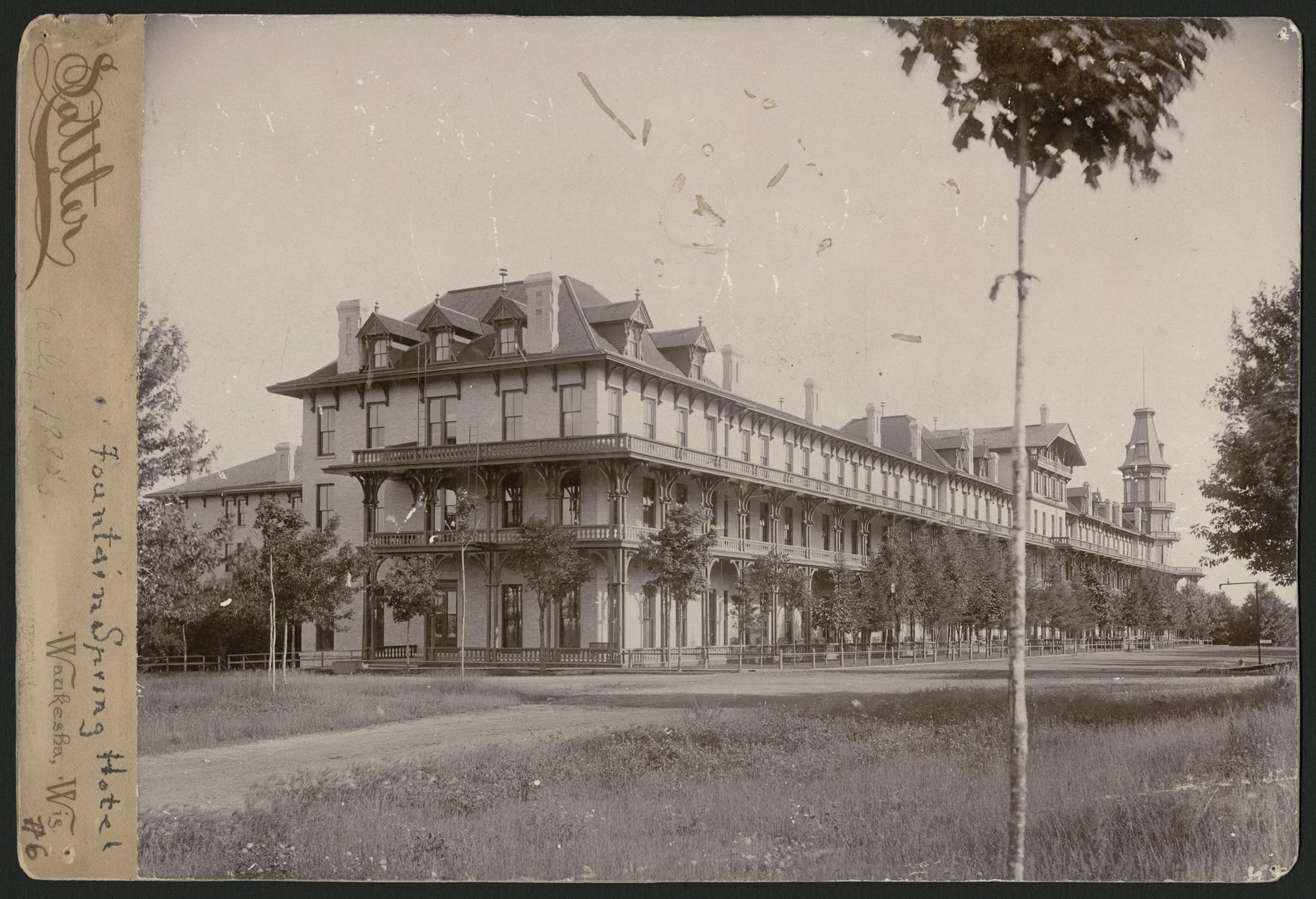
1874 – demolished 1950s Gone
Grand Avenue near Laflin Street, Waukesha
Fountain Spring House, Waukesha, Wisconsin

Fountain Spring House · Source: Waukesha County Historical Society & Museum

Matthew Laflin was one of Chicago's earliest real estate magnates. Born in Massachusetts in 1803, he spent decades acquiring and developing Chicago land, eventually owning some 140 acres within the city limits, purchased in the early years for around $300. In his later years he gave the Chicago Academy of Sciences to Lincoln Park. When he came to Waukesha and believed the waters had restored his health, he decided to build the finest summer hotel west of Saratoga Springs. He was seventy years old.

In March 1873, Laflin purchased 144 acres from Mr. and Mrs. Richard Smart for $1,500. The Fountain Spring House opened in July 1874 to immediate success. When a kitchen fire burned it to the ground in September 1878, he started rebuilding the next morning. The 1879 season opened on time with a hotel twice the original size.

At the spring's heart was an octagonal springhouse where an attendant named Eugene, called "My-gene" by the children who visited, would lower a rack of glasses into the crystal water on a track, like an elevator, and hand them up full to the guests seated around the edge. Visitors wrote about the experience for decades: the mirrored pebbled bottom, the almost unbelievable clarity of it.

Matthew Laflin died on May 20, 1897. In 1905, the hotel sold to the Metropolitan Church Association of Chicago. The bottling plant closed. The hotel was remodeled and eventually demolished in the 1950s. The lot sold in July 1956 for $1.00 and "other considerations." As the springhouse came down, someone photographed the cornerstone just before the bulldozers covered it. The photo ran in the Freeman.
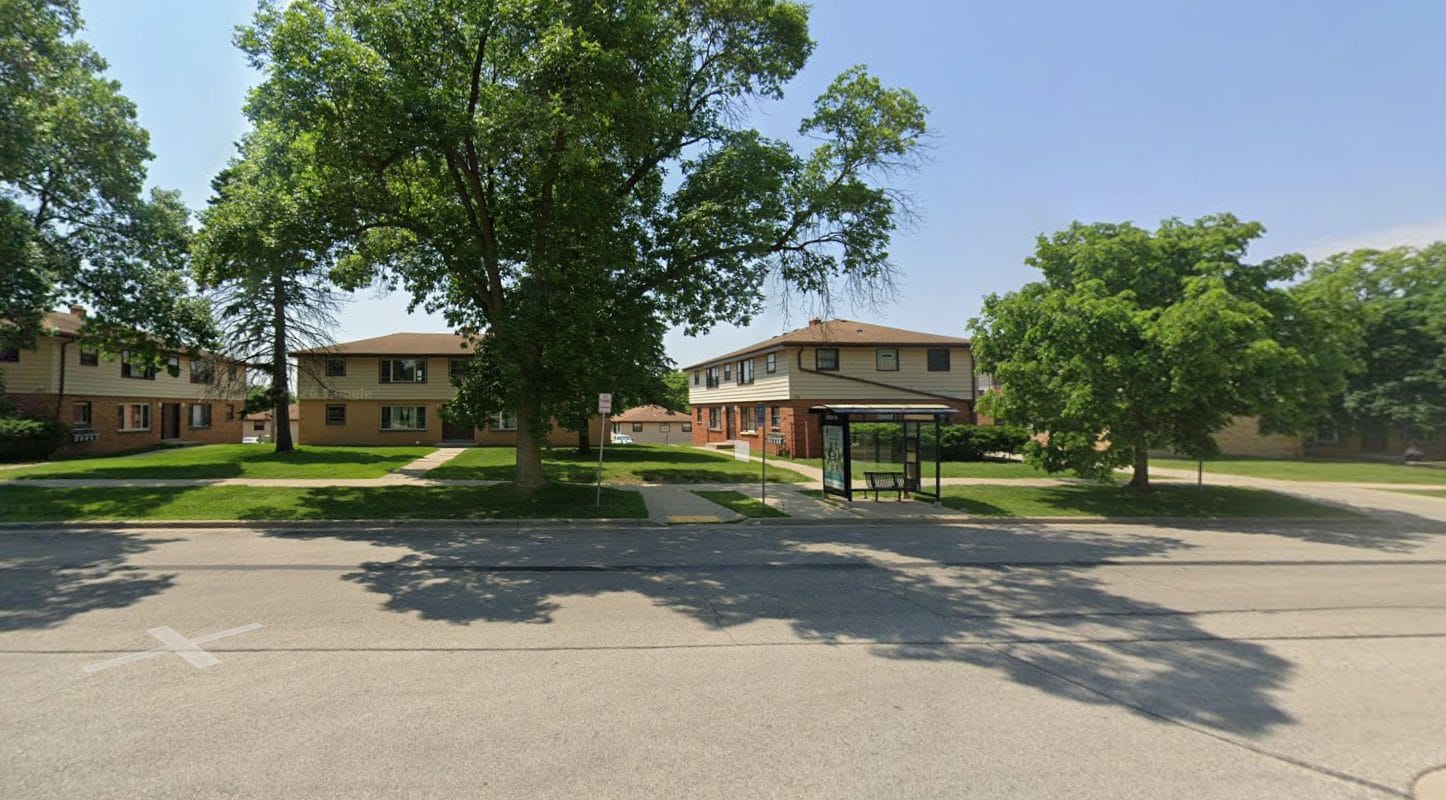
What stands there now
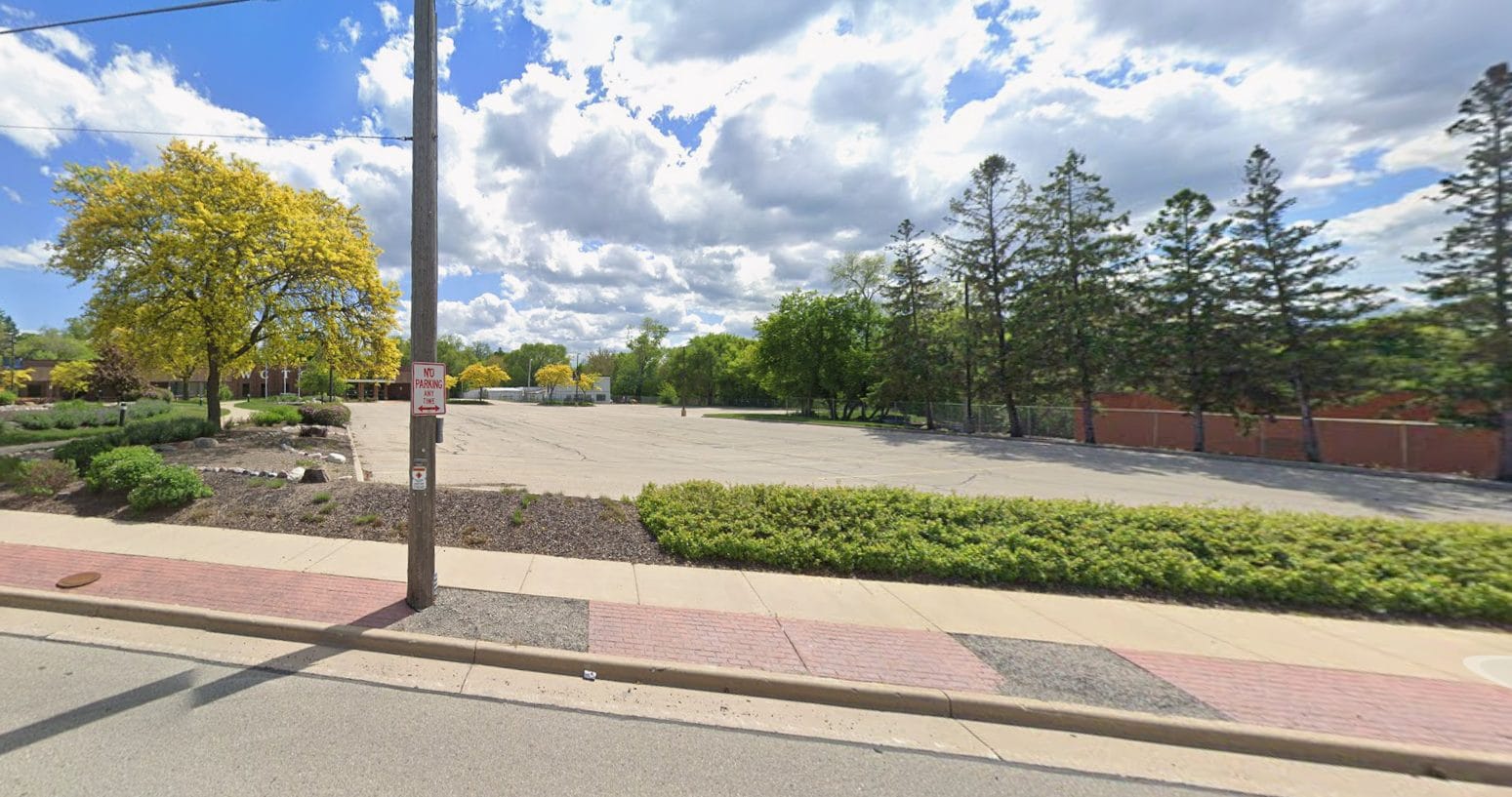
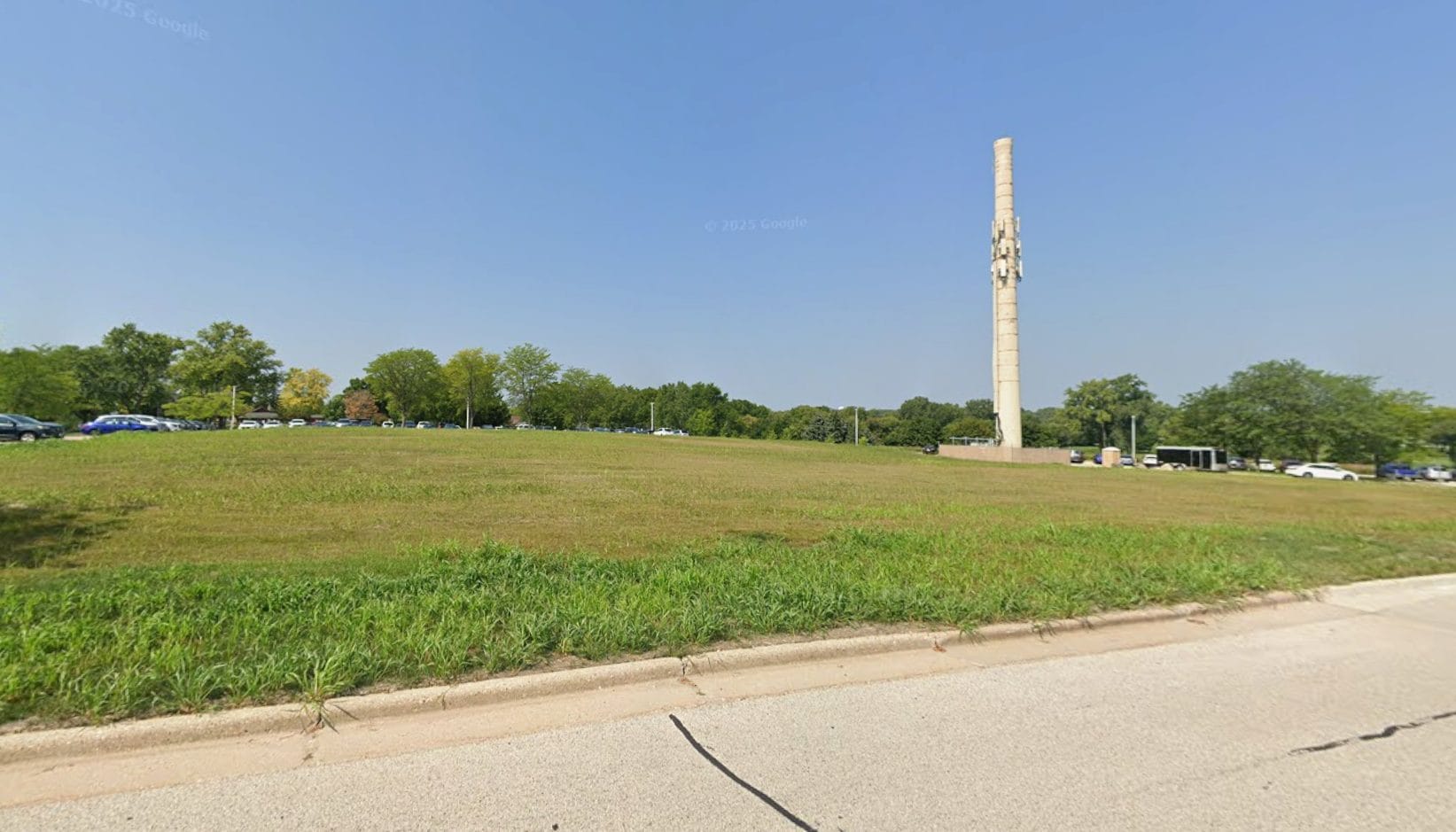
Site of the former Fountain Spring House, Waukesha, Wisconsin, present day
Commercial development along Grand Avenue. The lot sold in 1956 for a dollar. Laflin Street, one block south, still bears the builder's name.
est. 1868 / hotel 1890

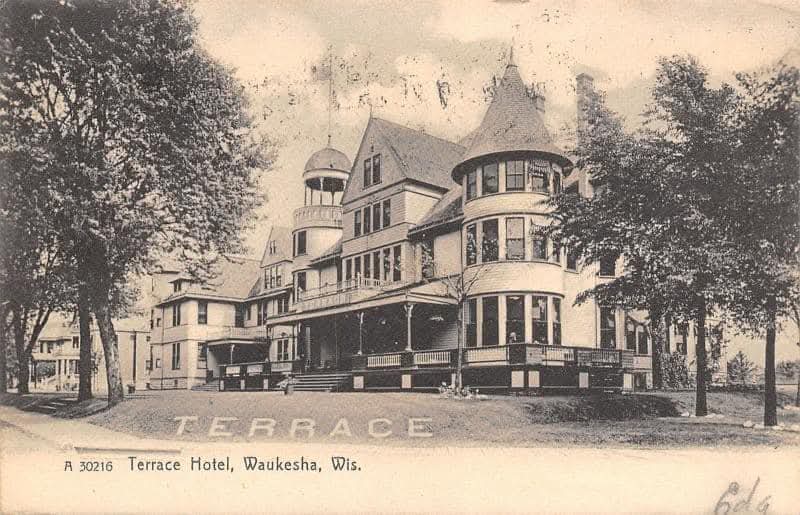
Bethesda Spring Park & The Terrace Hotel

Hotel open 1890 – closed 1927 Gone
Near Dunbar Avenue, Waukesha
Terrace Hotel, Waukesha, Wisconsin

Terrace Hotel · Source unknown

Everything starts here. In 1868, Colonel Richard Dunbar came to Waukesha to settle an estate, asked his sister-in-law Elizabeth Clarke Carney for a drink of water, and was pointed toward a spring in a nearby field. He bought the forty acres, named the spring Bethesda after the healing waters of Jerusalem, and began marketing the water nationally. By the early 1870s, Waukesha's hotels and boarding houses were overflowing with visitors who had read the testimonials and come to see for themselves.

Bethesda Spring Park grew up around the source over the following decades: formal grounds, a carved stone marker, a rustic pond, an entrance gate. By the summer of 1890, a local investor named Jones built a hotel directly across from that gate. The Terrace Hotel opened June 15, 1890, constructed at a cost of $10,000. The dining room ran 75 feet by 35 and seated 200. There were rooms for 100 guests. The landing on the main staircase was, as one Freeman reporter wrote, as large as a room in itself.

The Terrace is visible in period photographs of Bethesda Spring Park from around 1900, its long facade rising in the background behind the spring pond and the visitors in their white. It closed in 1927, one of the last of the original Springs Era hotels to shut its doors.

What stands there now
Site of the former Terrace Hotel, Waukesha, Wisconsin, present day
Bethesda Spring Park still exists near Dunbar Avenue. The original spring grounds survive. The Terrace Hotel is long gone.

Park Hotel

Gone
South side of Broadway, across from Silurian Spring Park, Waukesha
Park Hotel, Waukesha, Wisconsin

Park Hotel · Source: Waukesha County Historical Society & Museum

The Park Hotel stood on the south side of Broadway, directly across from Silurian Spring Park, and that location was the whole strategy. Silurian was one of the most developed resort complexes in Waukesha County, centered on a springhouse that drew visitors from across the city. The Park Hotel offered rooms across the street from all of it.

Where the Fountain Spring House and the Park View Hotel built their own spring grounds and resort infrastructure, this hotel's selling point was simpler: step outside and Waukesha's most active resort park was right in front of you.

Frances Stover, writing in the Milwaukee Journal in 1953, named the Park Hotel directly alongside Bethesda, Silurian, and the Fountain House as one of the places a former Southern visitor recalled when thinking of Waukesha at its best. That it landed in such company speaks to its standing.

What stands there now
Site of the former Park Hotel, Waukesha, Wisconsin, present day
The site on the south side of Broadway where the Park Hotel stood is now commercial development. Across the street, Waukesha Springs Park occupies the former Silurian Spring grounds.
est. 1881

Park View Hotel

1881 – burned 1914 Gone
St. Paul Avenue, Waukesha
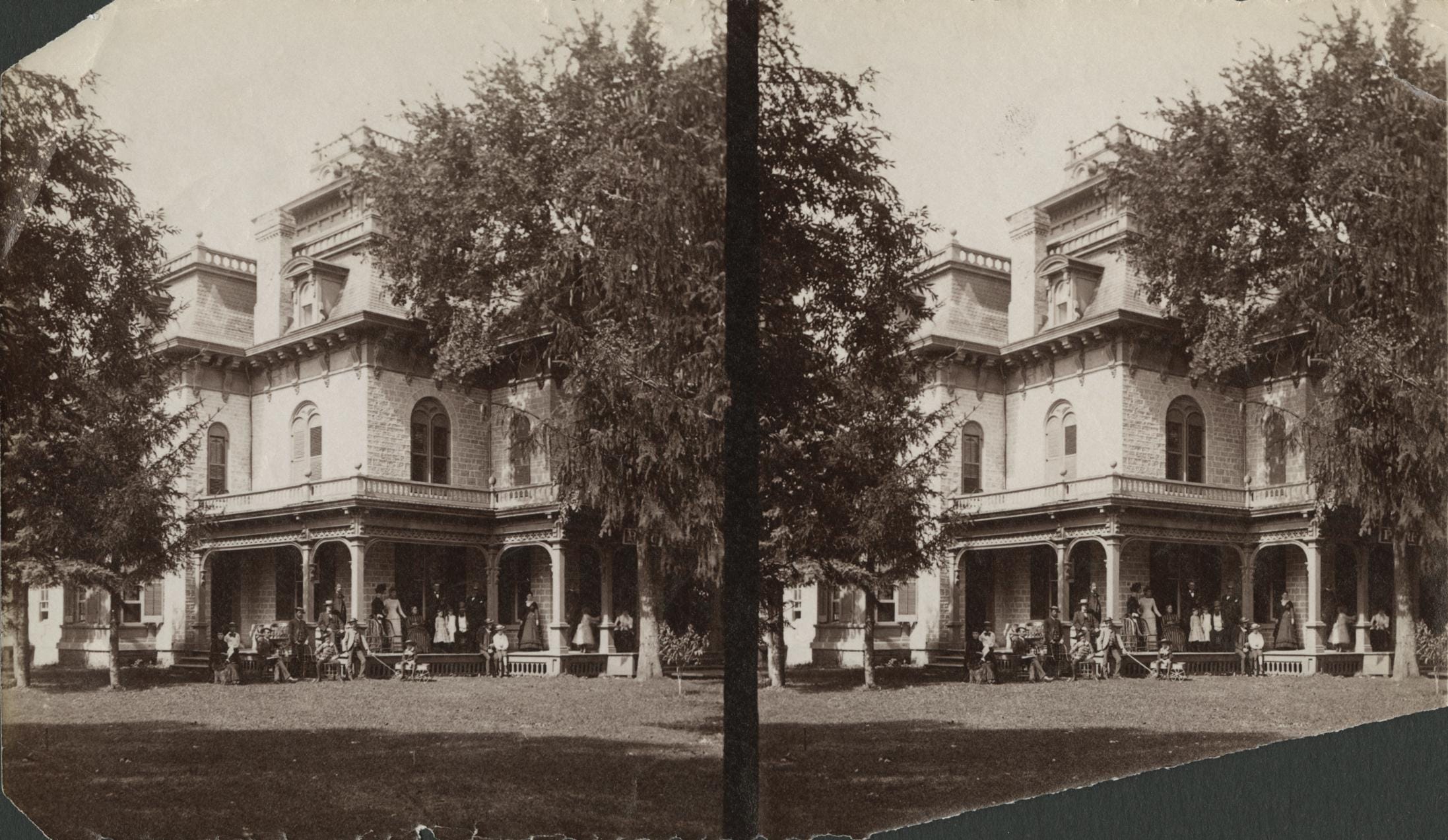
Park View Hotel, Waukesha, Wisconsin

Park View Hotel · Source: Waukesha County Historical Society & Museum

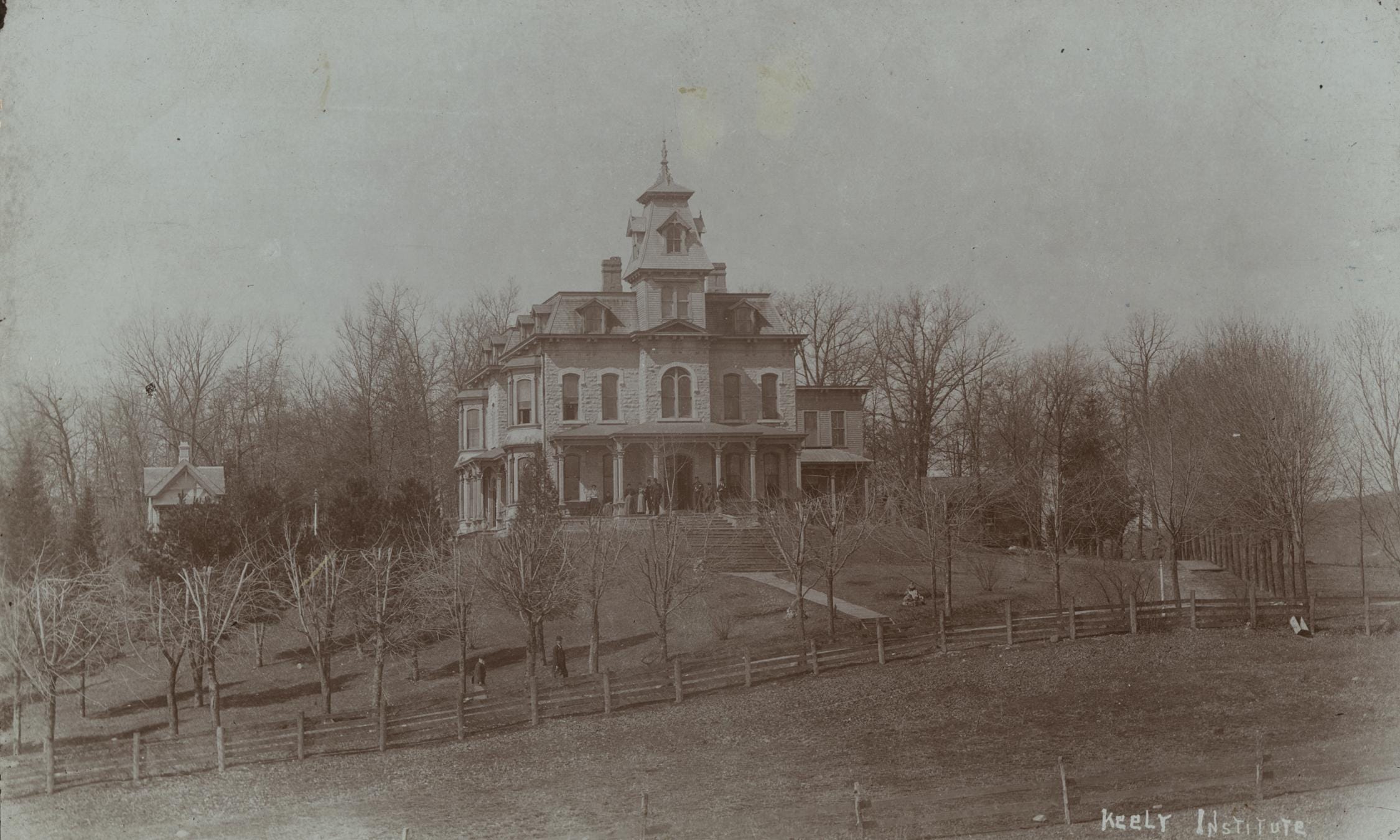
Julius Reise built his hotel on a hill, which was the point. When he opened the Park View in the summer of 1881 on St. Paul Avenue, he chose the high ground deliberately: a site opposite what is now the Waukesha Engine, on twenty acres with ten comprised of a luxurious oak grove, and a sixty-foot tower dominating the three-story building. Twelve-foot ceilings. An elegant dining room. Views no downtown hotel could match.

The property also had two natural mineral springs. By 1888, a W.H. Powers had taken management of the Alma Spring on the grounds, shipping ten barrels daily. By 1891, the enterprise had split into two commercial ventures, Alma Spring and Almanaris Spring, and incorporated with $100,000 in capital. A 1892 advertising brochure described the hotel as set "on an eminence of 50 feet above the river" with "the celebrated Almanaris Springs almost in front of the hotel."

In 1901, Powers attempted to sell the property to the Elks Club as a national headquarters. Delegates came from a Milwaukee convention to tour it. The offer was refused. The Almanaris bottling plant burned on February 8, 1904. 12:15 in the morning. Ten degrees below zero. The nearest hydrant was 1,500 feet away. Loss: $8,000.

In its final years, the Park View Hotel became the Keeley Institute of Wisconsin, treating alcohol and drug addiction — still trading on Waukesha's long association with therapeutic treatment, just for different ailments. The stone building, Second Empire style with a mansard roof and columns on the front porch, burned in 1914 and was never rebuilt.

What stands there now
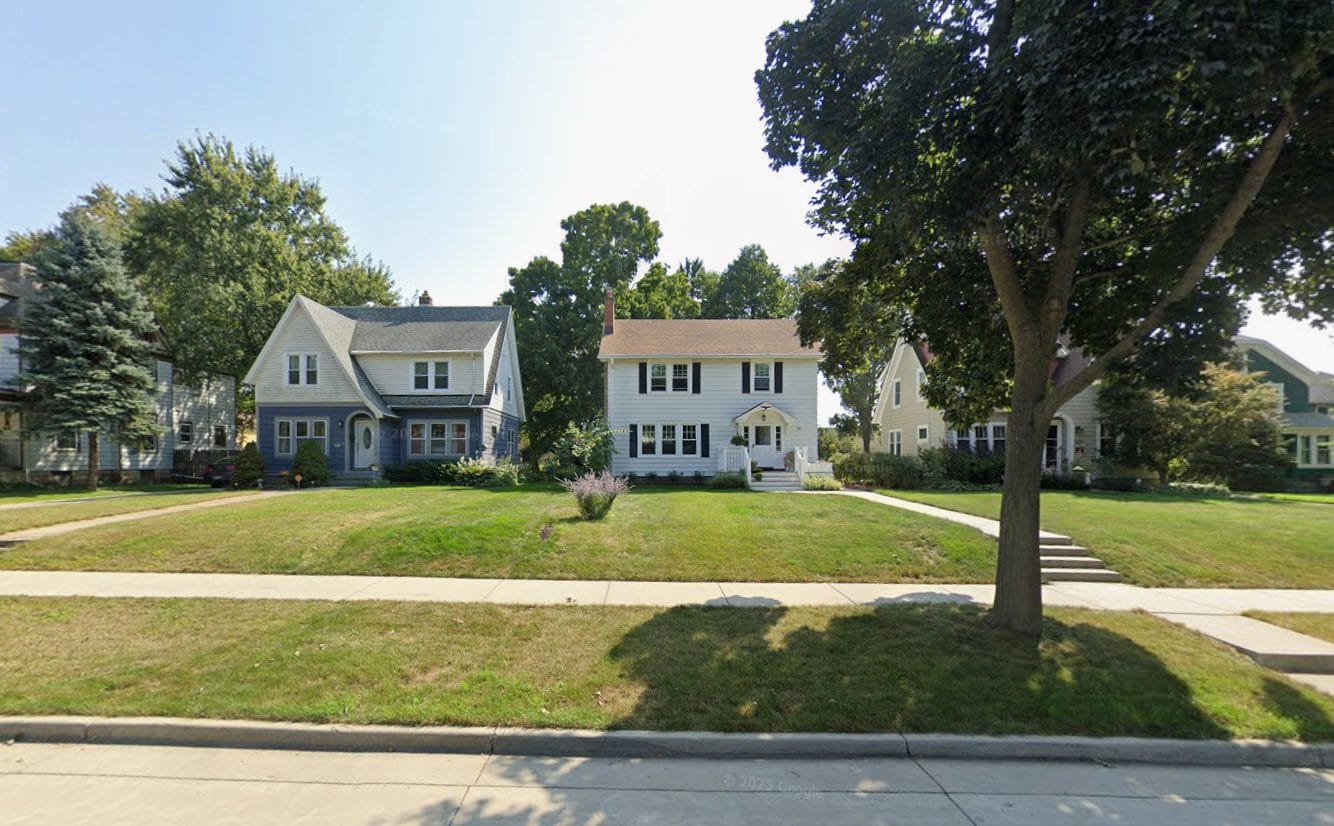
Site of the former Park View Hotel, Waukesha, Wisconsin, present day
The site is now part of the Dresser Waukesha Engine property on St. Paul Avenue. The Park View Hotel burned in 1914 and was never rebuilt.
est. 1885

Hyde Park Hotel

1885 – sold 1905, demolished c. 1906 Gone
NW corner of Madison & Spring Streets, Waukesha
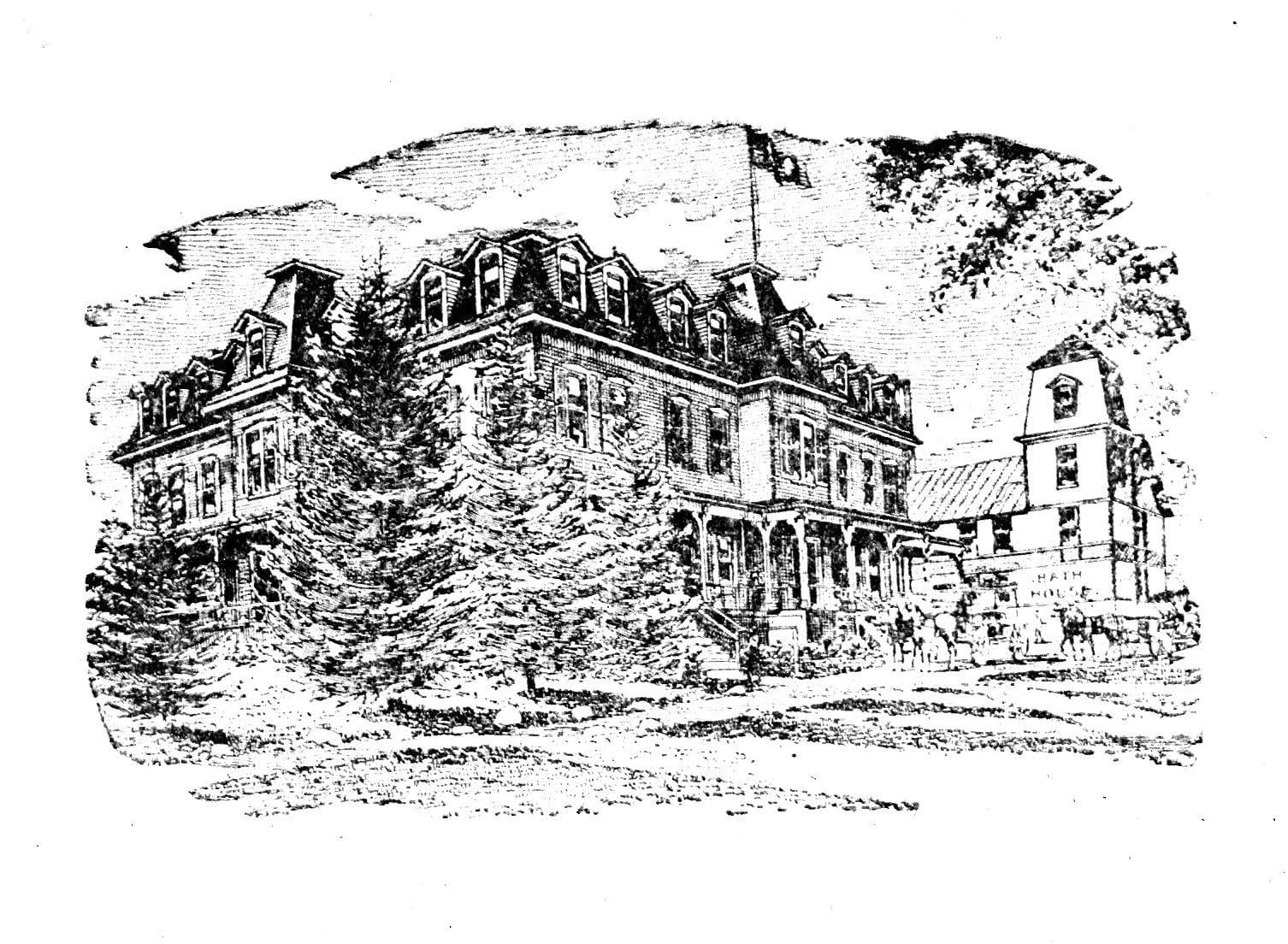
Hyde Park Hotel, Waukesha, Wisconsin

Hyde Park Hotel · Source: John Schoenknecht

Thomas Spence built his hotel because he believed in a spring he didn't own. He had attached himself to the Horeb Spring area on the north side of Waukesha, what the 1880 History of Waukesha County described as one of the most elevated springs in the vicinity, "boiling up through a bed of gravel" with "small globes of magnesia" visible in its crystal bed. He named the grounds Spence's Grove and spent years improving them.

In December 1884, he began construction of the Hyde Park Hotel at the northwest corner of Madison and Spring Streets. The building cost between $15,000 and $20,000: sixty rooms, 30 by 70 feet, steam heat, gas lighting. Its elevation was the selling point. "Cool summer breezes," one 1892 Freeman article called them.

The business struggled. Dr. J.P. Dargitz leased it in 1892, opened the Waukesha Sanitarium inside it, and left sixteen months later after a dispute over heating equipment. The hotel, park, and observation tower went on the market together in 1897. No buyers came. In 1905, the Hyde Park Hotel sold for $1,775. The new owner planned to demolish it.

On March 31, 1906, Thomas Spence was working on the second floor of one of the partially wrecked buildings on the grounds. He fell. He suffered internal injuries, a severely injured head, and a fractured thigh. He died two days later at age 83, on the ruins of what he had built. The observation tower came down not long after.

What stands there now
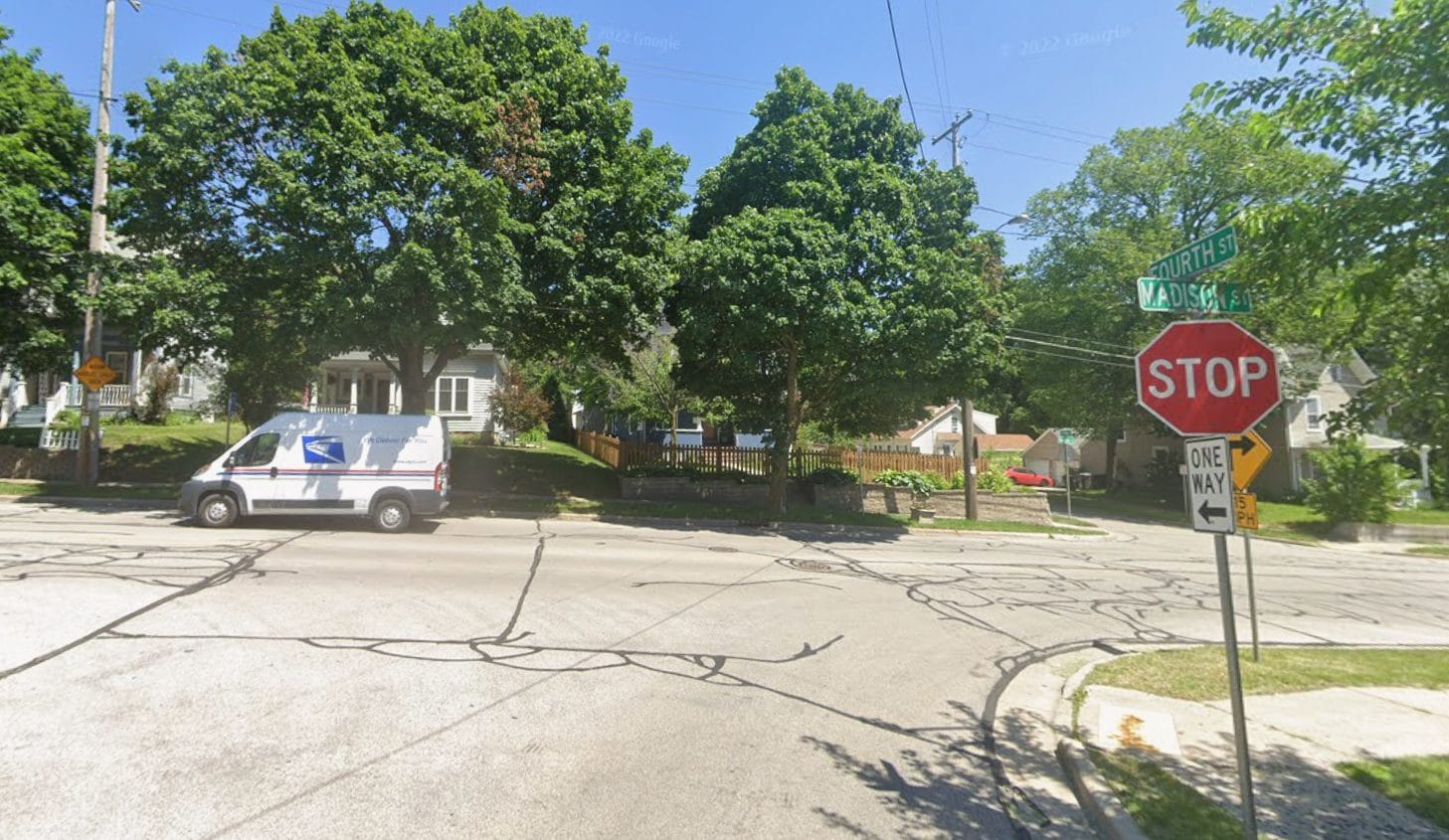
Site of the former Hyde Park Hotel, Waukesha, Wisconsin, present day
Thomas Spence died on the grounds in March 1906, two days after falling from the partially demolished building. The tower came down shortly after. Homes now occupy the site.
est. 1905

Resthaven Hotel

1905 – 1915 Building Survives
915 N. Hartwell Avenue, Waukesha
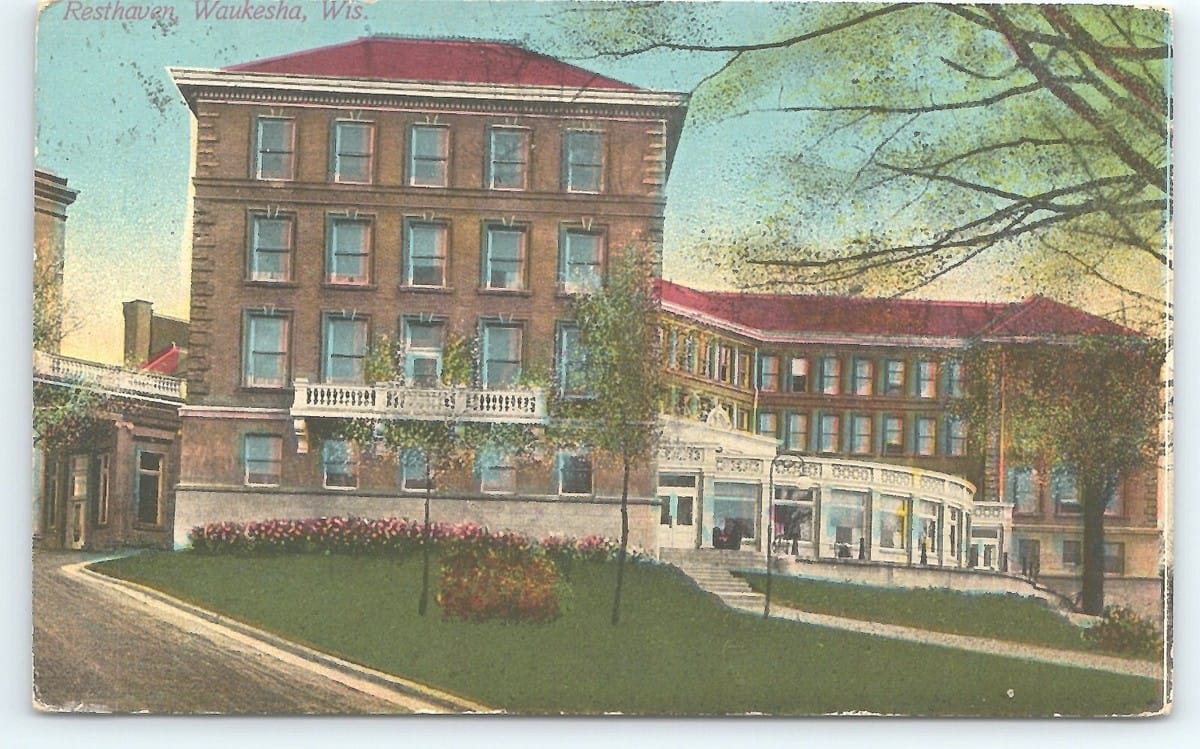
Resthaven Hotel, Waukesha, Wisconsin

Resthaven Hotel · 1912 postcard

By 1905, the Springs Era was losing its footing. The Fountain Spring House had just sold to a church. The Pure Food and Drug Act was a year away. But investors still believed in Waukesha.

The Resthaven opened in 1905 on a hilltop on Hartwell Avenue, looking out over the city below. The building was Classical Revival in style, Y-shaped in plan, with a spiraling grand staircase, deep woodwork throughout, and an indoor swimming pool. It was described at the time as the last of the grand resort hotels. That turned out to be accurate.

It operated as a resort for ten years, until 1915. Mineral water's reputation had collapsed under scientific scrutiny. The automobile was making it easy to go anywhere you liked. The Resthaven became a veterans' hospital, then a school. It's the only Springs Era hotel building in Waukesha still standing in a form you'd recognize. All the ones that were grander are gone.

What stands there now
Resthaven Hotel building, Waukesha, Wisconsin, present day
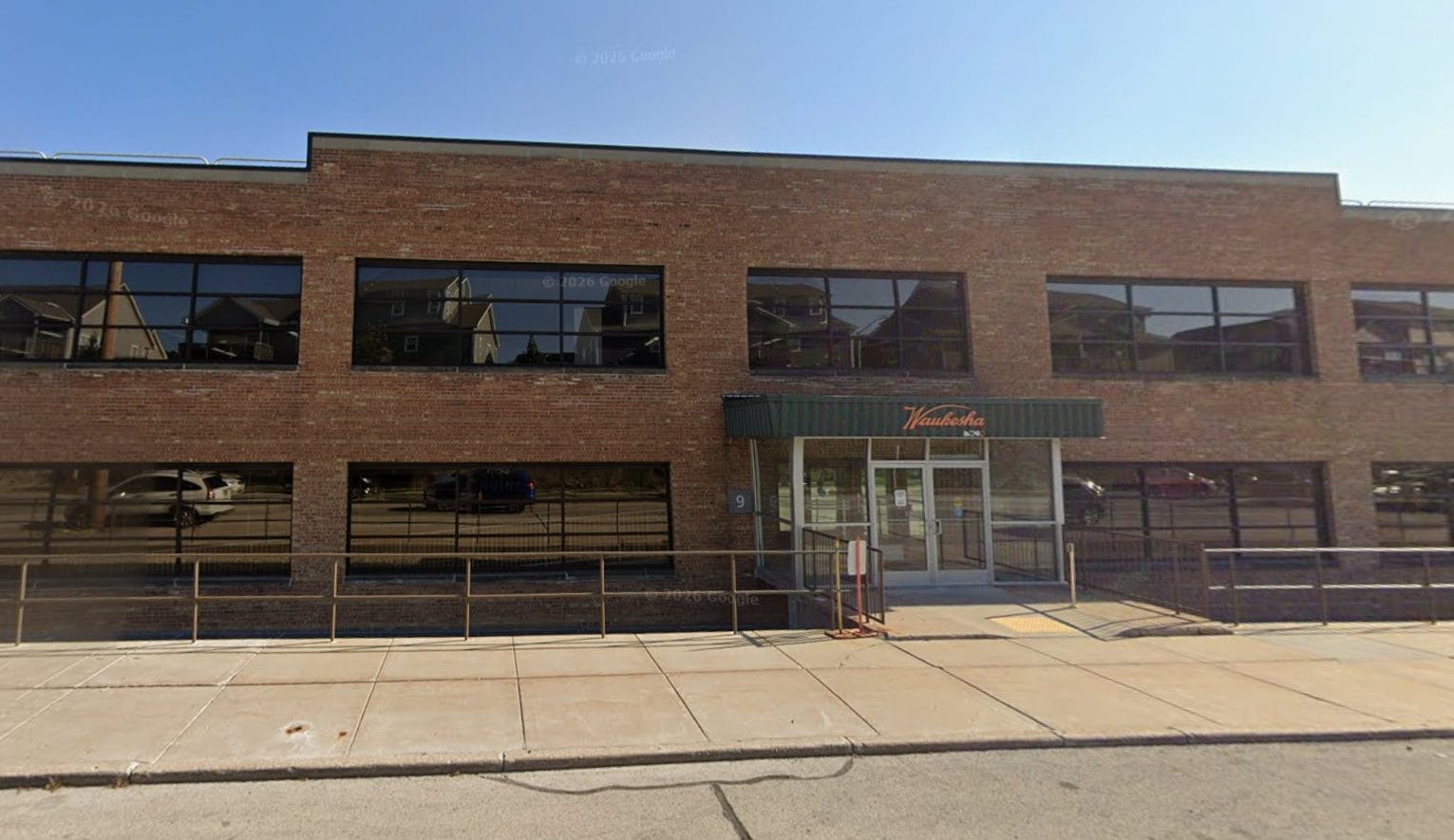
The building houses Ethnos360 Bible Institute today. It is listed on the National Register of Historic Places for the integrity of its Classical Revival architecture — one of the few Springs Era hotel buildings still standing in any recognizable form.
est. 1911

Grand View Health Resort & Moor Mud Baths

1911 – 1959, building demolished 2022 Partially Surviving
515 Moreland Boulevard, Waukesha
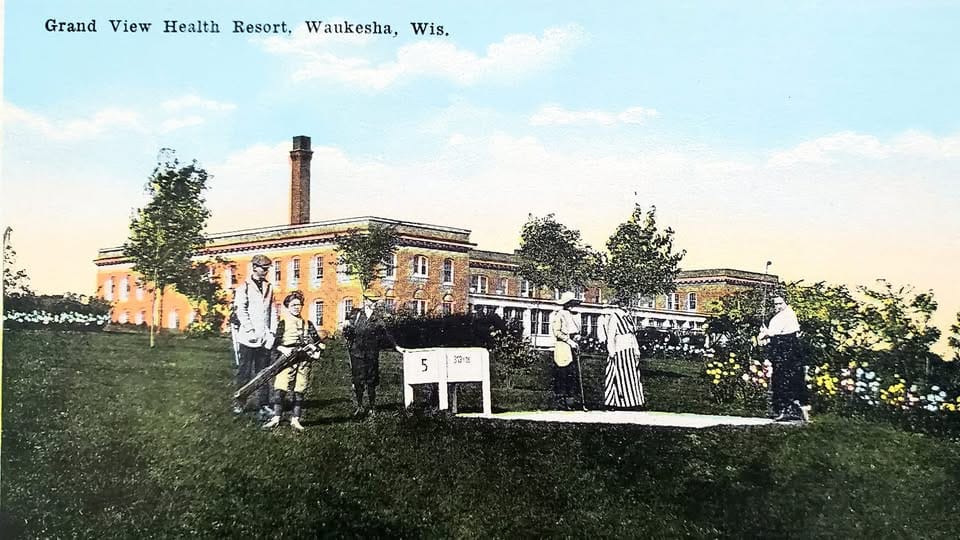
Grand View Health Resort, Waukesha, Wisconsin, circa 1915

Grand View Health Resort, c. 1915 · Source: Lisa Millen

The last resort to open during the Springs Era was the most forward-looking and the most unlikely. John Weber was a Milwaukee real estate agent when he purchased the property atop Prospect Avenue Hill in 1907. The land turned out to sit above a spring whose water emerged at an unusual 45 degrees, and the grounds contained deposits of dark peat soil. Weber recognized the potential and started building.

In 1911, Weber opened the Grand View Health Resort and Moor Mud Baths, offering warm mud treatments drawn from the property's own peat deposits. By 1912, he had capped the spring and built a springhouse over it, running pipe lines to the resort's supply tanks. The original hotel had 30 rooms; at its peak it held 200. A golf course, built in 1915 by Andrew Frame, wrapped around the property and still operates today as Moor Downs Golf Course.

From 1925 to 1947, over 130,000 people received the treatment. Through the Depression years the resort drew a wealthy Chicago clientele, known by then as much for the poker tables and fine dining as for the mud. The hotel closed in 1959. It became a seminary, then briefly a college, then county offices.

In 2022, the Waukesha Common Council voted to demolish the main structure, agreeing to preserve the springhouse and golf course clubhouse for the next ten years.

What stands there now
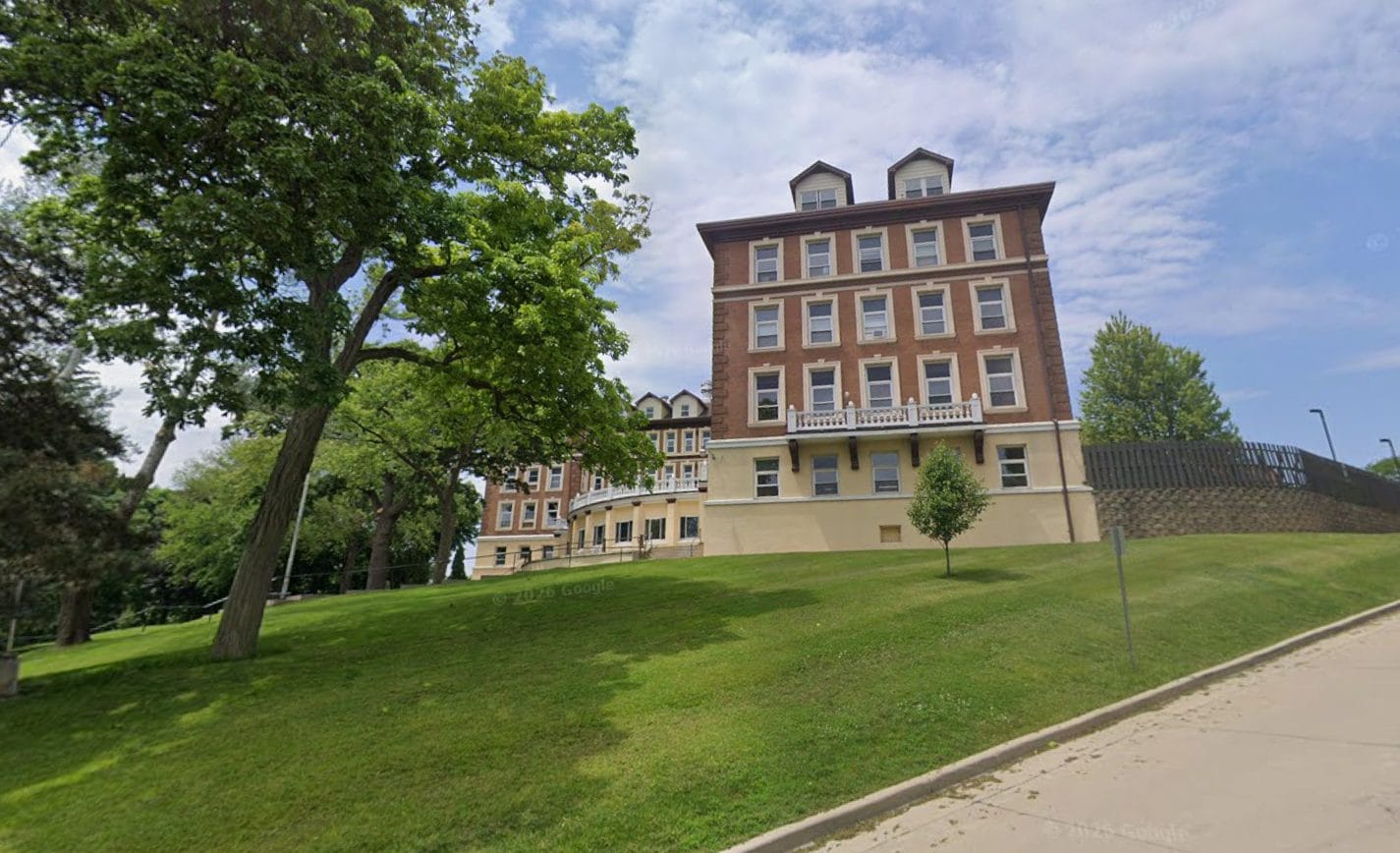
Site of the former Grand View Health Resort, Waukesha, Wisconsin, present day
The main hotel building was demolished after the 2022 council vote. The Moor Bath springhouse and golf course clubhouse were preserved. Moor Downs Golf Course, built in 1915, is still operated by Waukesha County. The springhouse sits along the fairways — golfers pass it daily, most not knowing what it once was.
Hotel by hotel
Openings & Closings
1874
Fountain Spring House opens
Matthew Laflin opens the grandest hotel of the era on Grand Avenue in July 1874, to immediate success.
1878
Fountain Spring House burns
A kitchen fire destroys the hotel. Laflin, at 75, begins rebuilding immediately. The 1879 season opens on time with a hotel twice the original size.
1881
Park View Hotel opens
Julius Reise builds a three-story hotel with a sixty-foot tower on St. Paul Avenue. Two mineral springs on the grounds become active commercial bottling operations.
1885
Hyde Park Hotel opens
Thomas Spence opens sixty rooms at the corner of Madison and Spring Streets, built around the Horeb Spring grounds he had been developing for years.
1890
Terrace Hotel opens
Built at a cost of $10,000 directly across from the Bethesda Spring entrance gate. Dining room for 200. Rooms for 100 guests. Opens June 15.
1905
Fountain Spring House sold; Resthaven opens
The grandest hotel of the era sells to a church. The same year, the Resthaven opens on Hartwell Avenue — described at the time as the last of the grand resort hotels.
1906
Thomas Spence dies on the Hyde Park grounds
Working on the second floor as demolition is underway, Spence falls and dies two days later at 83. The observation tower comes down shortly after.
1911
Grand View Health Resort opens
John Weber opens the Moor Mud Baths on Moreland Boulevard, patterned after German spa tradition. The last major resort hotel to open in Waukesha.
1914
Park View Hotel burns
By then operating as the Keeley Institute addiction treatment center, the hotel burns to the ground and is never rebuilt. The site passes to industry.
1915
Resthaven closes
Ten years after opening, the Resthaven ends its run as a resort hotel. It is the only Springs Era hotel building in Waukesha still standing in recognizable form.
1927
Terrace Hotel closes
After 37 years across from the Bethesda Spring entrance gate, the Terrace closes. One of the last of the original Springs Era hotels to shut its doors.
1956
Fountain Spring House demolished
The lot where the Fountain Spring stood sells in July 1956 for one dollar. Someone photographs the cornerstone just before the bulldozers cover it. The photo runs in the Freeman.
1959
Grand View closes
The last hotel of the era closes after 48 years. It becomes a seminary, then briefly a college, then county offices. The main building is demolished in 2022. The golf course and springhouse remain.
Today
What Remains

Resthaven / Ethnos360

The Classical Revival building at 915 N. Hartwell Avenue is the only Springs Era hotel still standing in recognizable form. Listed on the National Register of Historic Places. Now Ethnos360 Bible Institute.

Moor Bath Springhouse

Preserved when the Grand View main building was demolished in 2022. It sits along the Moor Downs fairways. Golfers pass it daily without knowing what it once was.

Moor Downs Golf Course

Built in 1915 as part of the Grand View Health Resort. Still operated by Waukesha County. One of the few pieces of Springs Era infrastructure still in use for its original purpose.

The era didn't collapse overnight. It eroded. The Pure Food and Drug Act of 1906 required evidence for medicinal claims, and the springs had none that science could verify. The automobile scattered what the train had concentrated. World War I accelerated everything. By the time the armistice came, the Springs Era hotels were already closing or converting, one by one.

What's remarkable, looking back, isn't that it ended. It's how completely it had transformed a small Wisconsin prairie town while it lasted. In forty years, Waukesha built a resort economy out of groundwater and Victorian optimism, drew visitors from every corner of the country, and hosted the social elite of the Gilded Age in hotels that could hold their own against anything east of the Mississippi.

The waters are quieter now. But they're still there, pushing up through the limestone under the parking lots and the engine plants and the fairways, the same water that convinced a thirsty man from New York, in a pasture in the summer of 1868, that he had been saved.

This feature is based on the author's personal research to the best of their ability. If you notice an error or have a correction to share, please get in touch.

Sources
  • The Great Waukesha Springs Era 1868–1918, John M. Schoenknecht
  • Frances Stover, Milwaukee Journal, June 1953
  • George W. Macauley, Little Wisconsin Town...Saratoga of the Midwest, Mayhew Press (via Schoenknecht)
  • Waukesha County Historical Society & Museum
  • UW Digital Collections — Park View Hotel / Keeley Institute, c. 1910
  • ArcGIS StoryMaps, Bethesda Park Historical Tour
Image Credits
  • Fountain Spring House — Waukesha County Historical Society & Museum
  • Park View Hotel — Waukesha County Historical Society & Museum
  • Park Hotel — Waukesha County Historical Society & Museum
  • Hyde Park Hotel — John Schoenknecht
  • Terrace Hotel — source unknown
  • Resthaven Hotel — 1912 postcard
  • Grand View Health Resort — c. 1915, Lisa Millen
  • All present-day site photographs — Google Maps / Street View